Processor die
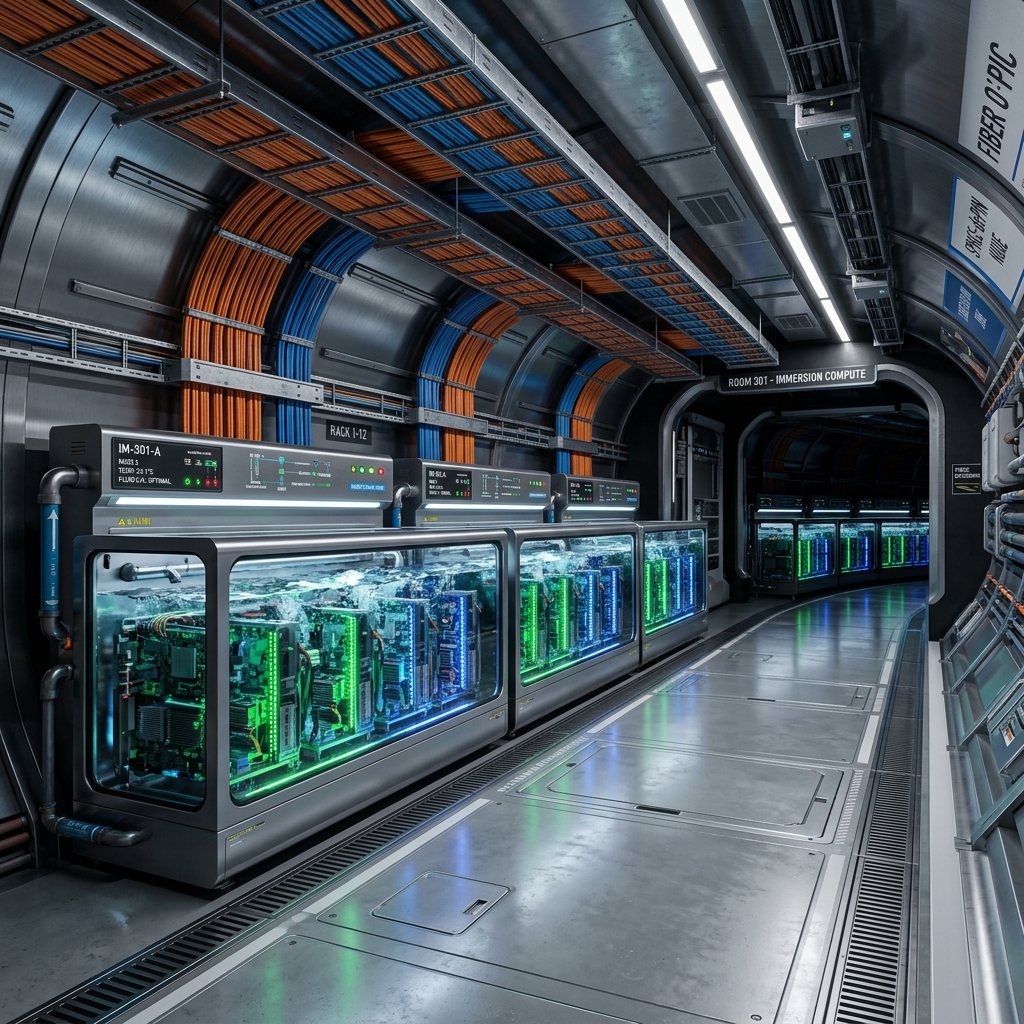
Carbon-based thermal interface moves heat into a direct cold plate.
ORBITAL COMPUTE / HOSTED PAYLOAD SPACE DePIN
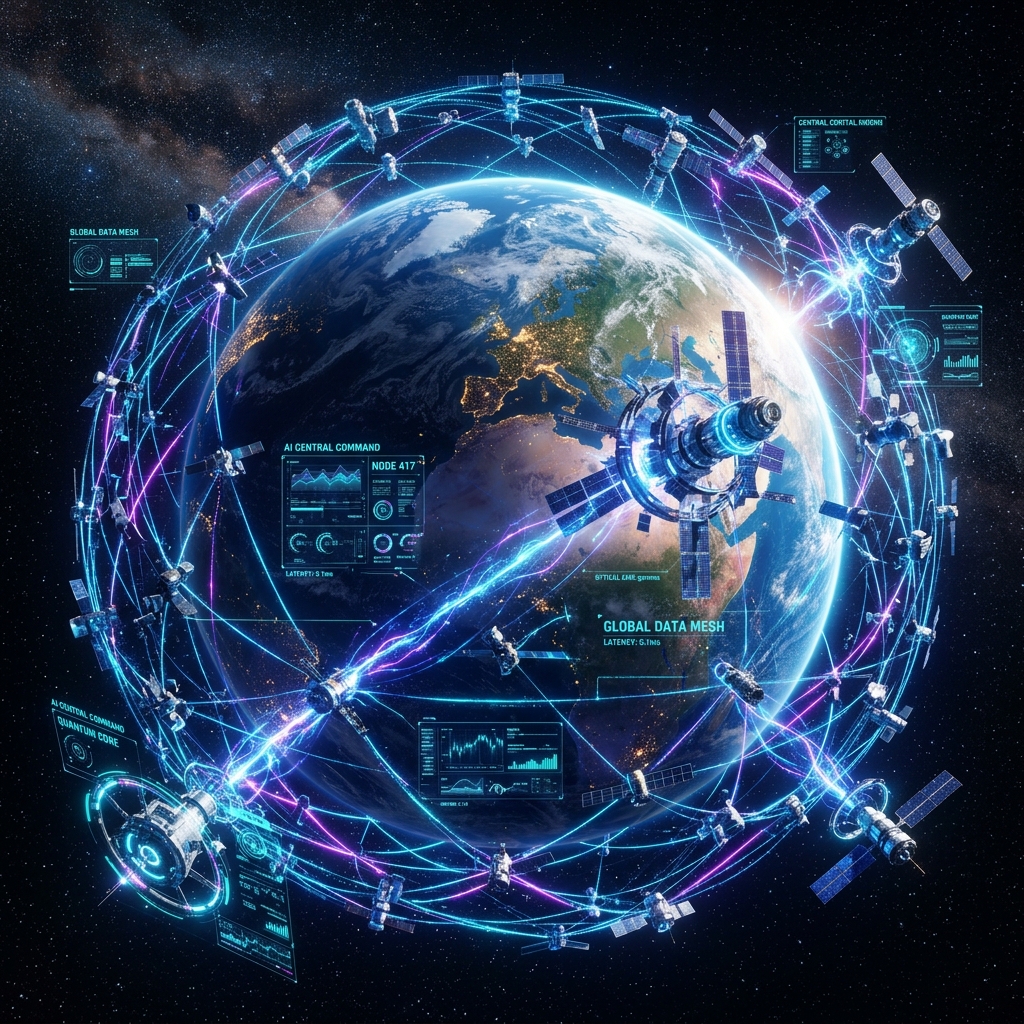
Proposed modular low-Earth-orbit infrastructure designed around radiative heat rejection, solar generation, optical cross-links, physical isolation and staged hosted payloads. Its advantage must be demonstrated workload by workload against strong terrestrial alternatives.
Without atmospheric convection, space hardware must conduct heat away from processors and reject it as infrared radiation. The design therefore begins with thermal architecture—not marketing.
P = εσA(Tᵣ⁴ − Tₛ⁴)Radiated power scales with emissivity, radiator area and the fourth power of radiator temperature.
Carbon-based thermal interface moves heat into a direct cold plate.
Two-phase working fluid carries heat through a passive capillary loop.
PCM absorbs transient compute peaks before radiator equilibrium.
High-emissivity surfaces maximize effective rejection area.
Waste heat leaves the spacecraft as electromagnetic radiation.
The current reference architecture models a low-power, radiation-aware compute and storage payload carried by a commercial host bus.
PC-104 class stack, enclosure, shielding, clock and dual S-band antenna allowance.
Dynamic hot/cold storage zones reduce idle thermal load.
Modeled five-year TID tolerance using graded-Z aluminum and tantalum concepts.
Magnetic non-volatile state storage for improved SEU tolerance.
S-band telemetry concept at up to 1024 kbps with Doppler tracking.
Proposed 1550 nm optical inter-satellite mesh.
Physical intervention is rare and expensive in orbit. The updated architecture therefore treats autonomy as a closed-loop resilience system that must first be matured and measured on terrestrial hardware.
Continuously monitor temperature, voltage, memory integrity and communication state.
Detect degradation trends early enough to create a safe migration window.
Move encrypted shards, validation duties and recoverable state to healthy nodes.
Power-gate and logically quarantine damaged cells, links or compute cores.
Later phases explore standard interfaces for modular orbital inspection or replacement.
Launch and initial commissioning do not establish durable service. POP’s 6 September requirements framework now treats attitude, power, thermal, communications, navigation, control authority, servicing and disposal as explicit failure domains—each with detection, containment, recovery and evidence gates.
Power-positive safe mode, command, timing and telemetry must outrank revenue workloads during attitude, battery or thermal degradation.
Authenticated checkpoints, separated replicas and partition-safe operation must preserve state while clearly marking when global finality is unavailable.
Conjunction inputs need source provenance and uncertainty records; safety-critical commands require legally accountable, threshold authorization.
Standard servicing interfaces may be evaluated, but continuity cannot depend on a successful rendezvous. Propellant reserves, abort rules, replacement and disposal remain part of the lifecycle model.
EVIDENCE TRIGGER / A real proximity mission reinforced the difference between commissioning and recoverable service: Katalyst LINK commissioning record and reported Swift approach outcome. These third-party events inform POP requirements; they do not validate POP capability.
Rather than funding a dedicated mega-constellation, PoP’s model places lightweight validator and storage payloads on compatible host spacecraft or deploys software onto qualified orbital compute.
Illustrative 48-node hosted-payload programme scope covering stated manufacturing, integration, ground/regulatory operations and replenishment assumptions. It is not a quoted price or complete delivered-compute TCO.
PoP is compared with credible terrestrial designs—not an artificially weak baseline. No column establishes a winner until equivalent workloads and full lifecycle boundaries are measured.
| PARAMETER | GRID-CONNECTED CAMPUS | DEDICATED-GENERATION CAMPUS | RENEWABLE-LINKED CAMPUS | POP ORBITAL ARCHITECTURE |
|---|---|---|---|---|
| Power boundary | Utility supply, UPS and backup generation | Onsite generation, fuel supply and optional grid support | Generation, storage, intermittency and grid contract | Solar generation, batteries, distribution loss and eclipse reserve |
| Thermal boundary | Air or liquid cooling; PUE and WUE | Facility cooling plus generation heat and parasitic loads | Facility cooling, location and seasonal constraints | Conduction, transport and radiator area/mass per kilowatt |
| Network boundary | Fibre routes and endpoint latency | Fibre routes and endpoint latency | Fibre or remote backhaul and endpoint latency | Inter-satellite links, downlink, gateways and fibre backhaul |
| Maintenance | Human access, repair and hardware refresh | Human access plus generation maintenance | Human or remote access plus storage replacement | Autonomous recovery, replenishment and failed-node replacement |
| Security & sovereignty | Jurisdiction and architecture dependent | Jurisdiction and architecture dependent | Jurisdiction and architecture dependent | Architecture dependent; physical separation does not remove legal control |
| Full-cost boundary | Site, grid, facility, cooling, network, refresh and finance | Site, generation, fuel, cooling, network, refresh and finance | Site, generation, storage, cooling, network, refresh and finance | Payload, bus, shielding, thermal, launch, insurance, ground, replacement, disposal and finance |
Comparison framework: POP Terrestrial Alternatives vs Orbital Benchmark, 5 September 2026. Values remain unpopulated until a common workload and evidence class are available.
POP does not assume that moving compute into orbit makes it greener. The 9 September measurement framework requires terrestrial and proposed orbital systems to be compared for the same useful workload and service level, with every result labelled by evidence class.
Include electricity source and losses, compute, networking, cooling, water, heat, buildings, land, noise, onsite generation, manufacture, refresh and disposal.
Include payload and bus manufacture, launch, failures, solar and battery systems, radiators, links, gateways, replenishment, ground operations and end of life.
Record the instrument or source, reporting period, workload denominator, boundary, exclusions, uncertainty, calculation version and assurance status.
“Zero-carbon,” “zero-water,” “clean” or “greener than terrestrial” remain prohibited unless matched lifecycle evidence and independent review support the exact statement.
Evidence trigger: Oracle’s 8 September 2026 Project Jupiter announcement describes planned public onsite reporting and independent assessments; it does not validate POP or provide POP measurements. POP framework: Environmental Measurement and Disclosure Framework, 9 September 2026.
The storage roadmap separates near-term design tiers from long-range research ceilings. “Usable” capacity is shown after the architecture’s modeled parity, logging, mirroring and replica reserve.
128 TB raw target · 4 kg class · 15 W peak · 2 W standby. A compact physically isolated archive and key-custody payload.
2.0 PB raw target · approximately 150 kg · 120 W peak. Active-active mirroring and Proof-of-Replica capacity reserve.
Long-range single-node research envelope; the upper case implies about 25 PB usable after parity/EDAC. It is not a current flight specification.
Data enters only during a scheduled, cryptographically authorized communications window.
Duty-cycled RF and power-domain isolation remove the continuous network path.
Erasure coding, replica proofs and cross-node shards protect against device loss.
Multi-party authorization reopens a bounded retrieval channel.
The economic thesis is not “space is cheap.” Hosted payloads may reduce ownership of a dedicated spacecraft and launch stack, but any claimed advantage must survive comparison with grid-connected, dedicated-generation and renewable-linked campuses after all lifecycle costs and useful workload output are counted.
Include power availability, site work, cooling, fibre, permitting, maintenance and financing.
Include onsite generation, fuel exposure, reliability, emissions, cooling and capital.
Include generation profile, storage, curtailment, modular compute and backhaul.
Include payload, bus, shielding, radiators, links, launch, insurance, ground, replacement, disposal and finance.
(1 − hosted scope ÷ selected dedicated-space scope) × 100
Internal initial manufacturing, launch and integration assumptions.
Stated ground/regulatory operations and rolling replenishment assumptions.
Illustrative scope difference; equivalent service and full lifecycle boundaries are not established.
Illustrative scope difference only; architecture and service scopes differ materially.
The proposed Goa R&D centre is intended as the orbital engineering core. The updated roadmap avoids rebuilding an entire national space supply chain: shared qualification capacity and flight-proven subsystems would be sourced, while POP’s differentiated compute, custody and consensus research would remain internal.
POP-BIONODE / GLOBAL BLACKOUT WATCH
Phase 3 explores a wrist-worn, ultra-low-power emergency wallet and alert interface designed to preserve authenticated messaging when conventional power, cellular and fibre infrastructure are unavailable.

Qualified institutions can request the air-gap vault, Goa R&D, MVP/POC, Phase‑3 and financial source packs after verification, final NDA execution and board approval.
Connect orbital compute to jurisdiction, key ownership, provenance, measurable resource economics and institutional Layer‑1 settlement.